
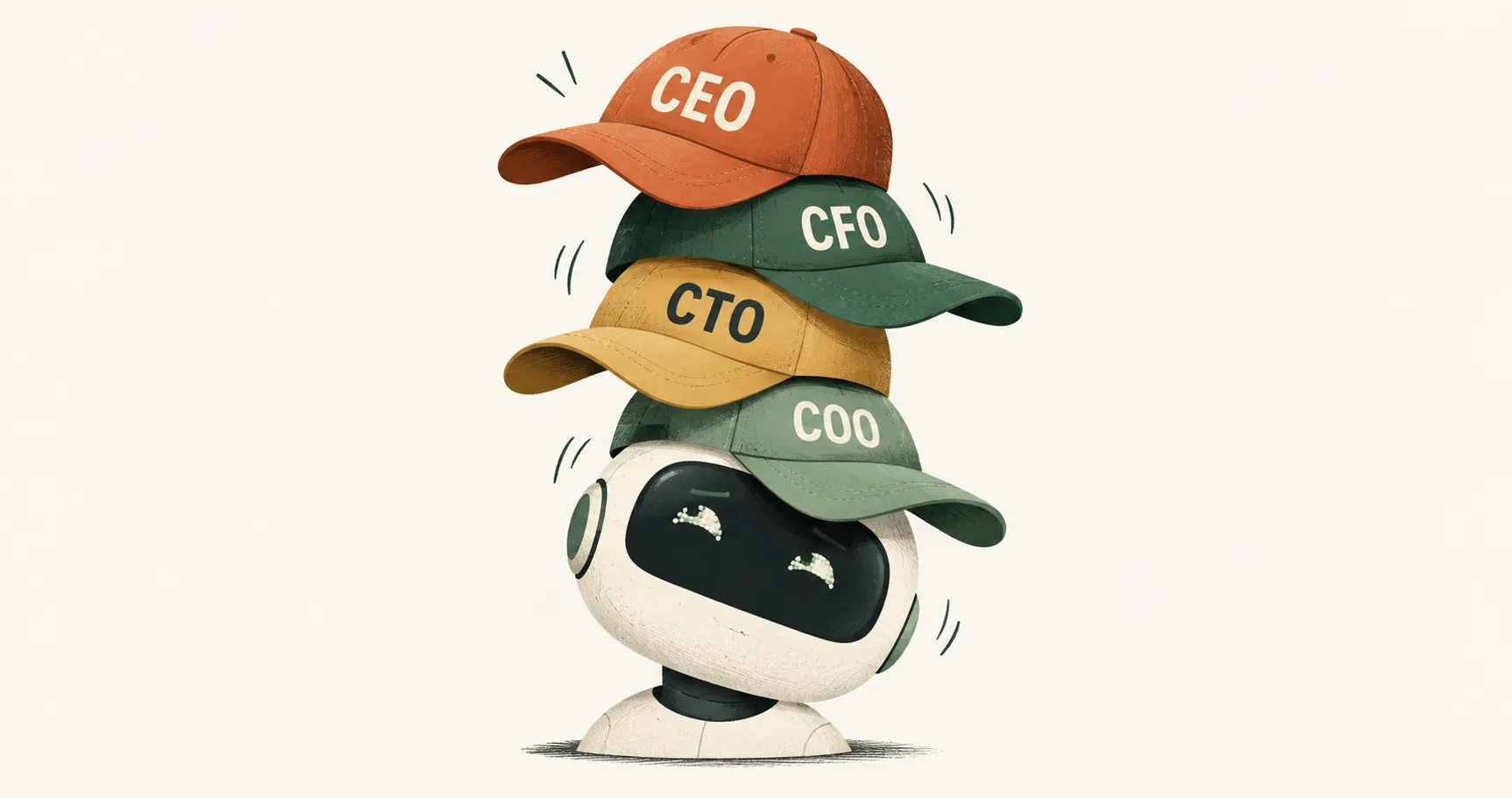
I've spent years developing software. Learning how systems work, solving problems, fixing things that break, and trying to make sure they don't break again.
But lately, I've been thinking.
Why did I spend all those years learning software development when apparently all I needed was AI?
And more importantly, why am I limiting myself to software?
I've decided to expand my career.
I'm now offering my services as your CEO, CFO, CTO, and COO.
All at once, if necessary.
I don't have an accounting background. I've never run your business. I probably don't know much about your industry.
But I have ChatGPT.
And I know how to write a pretty good prompt.
So, when can I start?
First, Let's Talk About Your Finances
Why hire an experienced CFO?
Give me access to your financial reports, and I'll have AI analyze them. I'll generate cash-flow projections, budgets, forecasts, and some beautiful charts.
I'll even put together a professional-looking report explaining what your company should do next.
Will I recognize a bad financial assumption? Will I understand the tax implications of a particular decision? Will I know when the numbers look right but tell the wrong story?
Probably not.
But I'll ask Claude to double-check everything.
Problem solved.
I Can Run the Company Too
As CEO, I'll have ChatGPT create your five-year plan, study your competitors, recommend new markets, and write inspiring messages to your employees.
I'll have a strategy for everything.
Whether those strategies make sense for your particular business is a different question.
But the presentation will be excellent.
And if the board asks something I don't know, I'll tell them it's a great question and that I'll get back to them.
Then I'll quietly open another chat.
And Your Operations? Consider Them Handled.
I'll use AI to improve your schedules, automate your workflows, and find ways to make your employees more productive.
I may not understand why your company does things a certain way or what could go wrong if I change them.
But Gemini says there's a more efficient way.
Who am I to argue?
And as for CTO? That's the one job I might actually understand. Unfortunately, it's also the one where I'd know enough to question what AI tells me.
Congratulations. You've just hired an entire executive team for the price of a few AI subscriptions.
Now, if you're a business owner reading this and thinking, This guy has no idea what he's getting himself into, we're getting somewhere.
Welcome to Software Development in 2026
Something amazing has happened.
People who have never written a line of code are building software.
And I don't mean simple websites.
They're building scheduling systems, customer portals, billing applications, inventory tools, and entire platforms for their businesses.
They describe what they want. AI writes the code. They click a button.
And it works.
Sometimes really well.
I think that's fantastic.
Seriously.
AI has opened doors that were closed to a lot of people. A business owner with a good idea can now build a working prototype without spending months finding a developer or investing thousands of dollars.
Someone who understands a business problem can create a tool to solve it.
That's a huge step forward.
But somewhere along the way, people started confusing two very different things.
Being able to build software and knowing how to develop software properly.
Everyone's a Developer Now
Here's something I've been seeing more and more.
Someone at a company has an idea. They open Claude, describe the booking system they want, and before long they've got it running on localhost:3000.
They show it to the business owner.
It looks great. There are buttons, dashboards, forms, maybe even a login screen.
Everyone's impressed.
And honestly, they should be. It's amazing what someone can build now without knowing how to code.
Then comes the next question.
"Can I get access to the server?"
Why?
"Claude says I need to deploy it."
And just like that, we've gone from experimenting with an idea to requesting access to the company's infrastructure.
Nobody has discussed where the data will live, how users will be authenticated, what happens if something breaks, or who's responsible for maintaining it.
But the demo works.
And Claude says we're ready.
To be fair, Claude may have given perfectly reasonable instructions. The problem isn't necessarily what AI recommended.
It's that the person following those instructions may not understand what they're being asked to do, or what the consequences might be.
There's a big difference between getting something to run on your laptop and putting it on a server where real people will depend on it.
Because there are questions that don't come up in a demo.
What happens when two customers try to book the same appointment at exactly the same time?
What happens when an employee gets access to information they shouldn't see?
What happens when a payment goes through but the system fails before recording it?
What happens when a small change breaks something that was working perfectly yesterday?
And who's going to fix it when nobody understands how the application works?
These aren't unusual situations. They're the kinds of things developers learn to think about before they happen.
Of course, AI can help solve these problems. It can even spot risks an experienced developer might miss, if someone thinks to ask.
But here's the question.
If you don't know these problems exist, how would you know to ask AI about them?
That's the difference.
Writing code is only part of software development. A big part of the job is knowing what questions to ask, what can go wrong, and how to make decisions that won't create bigger problems later.
Even the Experts Know There's a Difference
In February 2025, Andrej Karpathy, an OpenAI co-founder and former director of AI at Tesla, introduced the term vibe coding in "a post on X" (https://x.com/karpathy/status/1886192184808149383).
He described a way of building software where you tell AI what you want, accept the code it produces, and keep going without worrying too much about what's happening underneath.
It's an exciting approach, and it's helped change how people think about building software.
But there's a detail in his original post worth noticing.
He described the approach as suitable for throwaway weekend projects.
That's quite different from building a system that a business depends on every day.
And Karpathy isn't someone who lacks technical experience. He's spent years working at the highest levels of software and AI development.
When someone like him decides not to worry about every line of code in a quick experiment, he's making that choice with a deep understanding of what he's doing.
When someone who has never developed software does the same thing, they may not even realize what they're choosing to ignore.
It's like watching an experienced chef prepare a meal without a recipe.
The chef knows which steps matter, what can be changed, and how to recognize when something is going wrong.
Someone who's never cooked might try the same approach and end up with something very different.
The recipe isn't what makes the chef an expert.
It's the experience behind the decisions.
AI Makes Experience More Powerful
Simon Willison, a respected software developer who helped create the Django web framework, is another example.
In an "April 2026 interview on Lenny's Podcast" (https://simonwillison.net/2026/Apr/2/lennys-podcast/), he said that AI now writes about 95% of his code.
But here's the part that caught my attention.
He also explained that using coding agents effectively draws on his entire 25 years of experience as a software engineer.
And he described the work as mentally exhausting.
Think about that.
Here's someone who has spent decades developing software. AI is now doing much of the actual coding for him, yet he's still relying heavily on everything he's learned over those years.
The typing has become easier. The thinking hasn't necessarily become easier.
He's still making decisions, evaluating results, recognizing problems, and figuring out what needs to happen next.
A beginner and an experienced developer can ask AI the exact same question. They might even get the exact same answer.
But they won't necessarily know what to do with it in the same way.
AI can give you an answer. Experience helps you know whether it's the right answer.
And sometimes, experience helps you realize you were asking the wrong question altogether.
The Problem Is That Bad Work Can Look Really Good
This is one of the trickiest things about AI.
It can produce work that looks incredibly professional. The code is neat, the financial reports are polished, the business plans sound convincing, and the explanations are clear and confident.
But looking professional and being correct aren't the same thing.
If I asked AI to prepare your company's financial strategy, I might get a very impressive report. An experienced CFO might read that same report and immediately notice a serious problem.
Not because they have access to better AI.
Because they understand finance.
They know what to look for. They've seen what happens when certain assumptions turn out to be wrong, and they understand the consequences of making the wrong decision.
Software is no different.
A developer's experience isn't just about knowing how to write code. It's about understanding security, performance, reliability, and all the little details that don't show up in a nice demo.
It's also about knowing when a simple solution is enough and when something needs more careful planning.
And perhaps most importantly, it's about recognizing problems that someone without experience might never think to look for.
The Job Is Changing, Not Disappearing
Here's something else worth considering.
Some experienced developers barely read the code AI generates anymore.
Not because they've stopped caring about quality, but because AI can produce so much code that reviewing every line is becoming less practical.
In "an article published in Level Up Coding" (https://levelup.gitconnected.com/i-barely-read-my-ais-code-anymore-here-s-what-i-check-instead-d0ca8e4573af), a developer with more than two decades of experience explains that he now spends less time reading code and more time examining the decisions AI makes.
He uses documentation, other AI agents, diagrams, and testing to understand whether the system is doing what it should.
And he raises a point that I think is especially important.
AI doesn't just write code. It makes decisions along the way, including decisions nobody specifically asked it to make.
Someone still needs to recognize those decisions, question them, and decide whether they're appropriate.
That's where experience comes in.
The developer's job is changing. But the need for someone who understands what they're building hasn't gone away.
That Doesn't Mean Everyone Needs a Developer
I also think developers need to be careful here.
Not every project needs an experienced software engineer. Not every application needs to be built for millions of users. Sometimes a simple AI-generated tool is exactly what a business needs.
And sometimes a business owner who understands the problem deeply will build something more useful than a developer who doesn't understand the business at all.
AI is making that possible, and it's a good thing.
It's also getting better very quickly. The things AI struggles with today may be much easier tomorrow.
So I don't think the argument should be that AI can't do professional work. It clearly can do a lot of it already.
The more important question is what happens when we confuse the ability to produce work with the ability to judge it.
A calculator can do complicated math. That doesn't make everyone an accountant.
And AI can write software. That doesn't automatically make everyone a software engineer.
The tools are becoming easier to use, but the responsibility for the results hasn't disappeared.
So, Am I Hired?
I'm still happy to be your CEO.
And CFO.
And COO.
I'll even throw in the CTO position.
I've got ChatGPT to develop the strategy, Claude to review it, and Gemini to give me a second opinion.
And if they all disagree?
I'll ask ChatGPT to summarize the disagreement and recommend the best answer.
See? Leadership.
But here's the thing.
When something important goes wrong, you'll probably want someone who actually understands your business making the decisions.
Software development is no different.
I'm not saying business owners shouldn't use AI to build software. Please do. Build things. Experiment. Solve problems. AI is making incredible things possible.
Just understand that getting an application to work and knowing whether it's been built properly are two different things.
And the most dangerous problems are often the ones you never thought to ask about.
AI can help you do the work of an expert. That doesn't automatically make you one.
Anyway, I've already had ChatGPT write my executive résumé.
Claude reviewed it.
Gemini says I'm overqualified.
I just need one little thing before I start.
Can I get access to your bank accounts?
AI says that's the next step.