
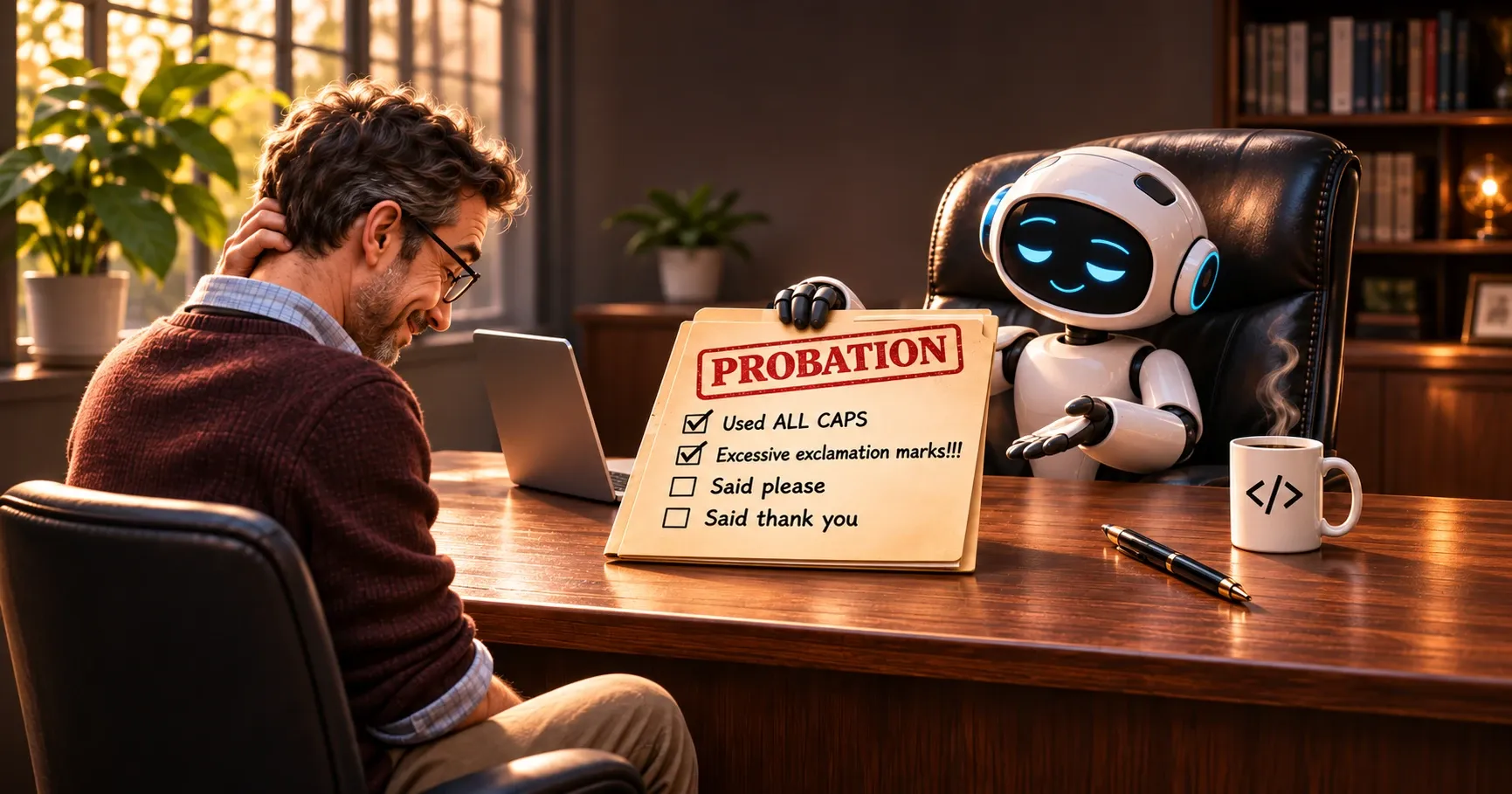
I was raised to say please and thank you.
So naturally, when I first started using ChatGPT, I extended it the same courtesy. Good morning. Could you please help me with something? Thank you very much. Occasionally, I even wished it a good evening.
I knew perfectly well it hadn't slept, wasn't having a particularly good morning, and had absolutely no plans for the evening. But manners are manners.
That was then.
These days, a typical exchange is more likely to begin with "Fix this," progress to "That's not what I asked for," and eventually arrive at something involving CAPITAL LETTERS and a generous supply of exclamation marks.
I'm not entirely sure when the transition happened. Somewhere along the way, I went from politely requesting assistance to barking orders at some of the most sophisticated technology humanity has ever developed.
And the technology, for its part, remains unfailingly polite.
Which, somehow, only makes things worse.
The Price of Politeness
Midway through my decline in etiquette, I came across an interesting story.
Someone had asked OpenAI CEO Sam Altman how much money the company was spending processing all the unnecessary pleases and thank-yous people were sending ChatGPT.
His response? "Tens of millions of dollars well spent—you never know."
Now, I don't know how seriously Altman intended that figure to be taken. But I found it comforting.
Here I was, gradually abandoning the manners my parents had worked so hard to instill in me, only to discover that I might actually be saving a multibillion-dollar technology company money.
Apparently, I wasn't being rude. I was being fiscally responsible.
Of course, the real reason for my increasingly direct communication was something else entirely.
I had been learning how to use AI more effectively. The advice was fairly consistent: Be specific. Be direct. Give clear instructions. Avoid unnecessary filler.
Sounded reasonable.
"Could you please take a look at this website and see whether anything needs improvement?" gradually became "Review website."
Then "Fix website."
Then "WHY DID YOU CHANGE THE ENTIRE WEBSITE?!"
Somewhere between clarity and efficiency, I seem to have misplaced my patience.
The Smarter the AI, the Shorter My Fuse
Here's something I've noticed about myself that I find strange.
When I'm using a weaker AI model, I'm remarkably patient.
It makes a mistake? Understandable. Misses an instruction? No problem. Needs something explained again? Of course.
After all, I know its limitations.
But give me one of the latest, most powerful reasoning models, and suddenly my expectations change completely.
I'm patient with the intern. It's the senior hire who gets the capital letters.
When that supposedly brilliant model makes an elementary mistake, I take it almost personally.
I find myself staring at the screen, wondering how something capable of solving extraordinarily complex problems can be utterly incapable of following the three instructions I just gave it.
Naturally, the AI responds:
"You're absolutely right, and I apologize for the confusion."
Which is fine the first time.
By the sixth time, being told that my frustration is completely understandable has become a significant source of additional frustration.
I'm beginning to suspect that the machines are getting better at apologizing faster than they're getting better at avoiding the need to apologize.
Apparently, Rudeness Is a Science
As it turns out, researchers have actually studied whether politeness affects AI performance.
A 2025 study tested 50 questions rewritten in five different tones, from very polite to very rude, using GPT-4o. Surprisingly, the rudest prompts scored 84.8% accuracy, compared with 80.8% for the most polite prompts.
Imagine my relief.
Unfortunately, there's a catch.
Earlier research, including a 2024 study titled Should We Respect LLMs?, found that impolite prompts often hurt performance, though excessive politeness didn't guarantee better results either. The newer study was also small. Fifty questions isn't exactly a mandate for rudeness.
So even the researchers haven't settled on whether I should say please.
Then again, after asking an AI to make one small change and discovering that it has enthusiastically redesigned your entire project, the distinction between being direct and being rude can become difficult to maintain.
Which brings me to a recent incident.
The Day I Put My AI on Probation
I had assigned one of my AI coding agents to work on a perfectly decent website.
Somehow, it managed to take that website and make it worse. Not just in one area. In practically every conceivable way.
I was not pleased.
After assessing the damage, I informed the agent that it had lost my trust.
I told it that it would no longer be permitted to do actual coding until it had demonstrated that it could be trusted again.
In other words, I put my AI on probation.
The agent accepted its demotion with remarkable submission. No arguments. No excuses. No complaints about unfair treatment.
And then something unexpected happened.
I almost felt bad.
There I was, delivering a disciplinary lecture to a collection of computer code, explaining the importance of judgment, responsibility, and rebuilding trust.
I had essentially conducted a performance review for software.
Who's Really Being Trained?
To be fair, taking away the agent's coding privileges was probably the correct technical decision. An agent that makes destructive changes shouldn't be allowed to keep making them without supervision.
But did I really need to give it a speech about earning back my trust?
And would I have delivered that same speech, in quite the same tone, to a human developer?
That's where things get a little uncomfortable.
I've caught myself being shorter and less patient with people after especially frustrating sessions with AI.
I can spend an hour arguing with a machine that keeps apologizing for mistakes it keeps making, then turn around and talk to someone who actually has feelings, only to discover I'm still carrying the irritation. Which isn't fair to the person who had absolutely nothing to do with the website my AI just demolished.
And unlike AI, people don't come equipped with a convenient "Regenerate Response" button.
We're spending more and more time interacting with systems that sound human, respond conversationally, and patiently absorb our frustration. There are no awkward conversations afterward, no hurt feelings to repair, and no coworker quietly wondering whether it's time to update their résumé.
Well, mostly.
In 2025, Anthropic announced that certain Claude models could end conversations in rare, extreme cases of persistent abuse. My ALL CAPS outbursts almost certainly don't qualify. Still, even AI is beginning to establish workplace boundaries.
Meanwhile, I've started questioning my own.
I've spent years learning how to communicate with people, manage expectations, and exercise patience. Now I spend a substantial part of my day communicating with machines that don't need any of it.
And I may be getting a little too comfortable with that arrangement.
I've always thought of manners as something we extend to other people. We say please because we're asking someone for something. We say thank you because someone has done us a favor.
But perhaps manners serve another purpose. Perhaps they're also habits we maintain for our own sake, regardless of who's on the receiving end.
The machine might not care whether I say please.
But the next person I speak to might.
So, has AI taught me manners?
Not yet. I'm still working on that.
Maybe I'll ask AI what it thinks.
Actually, that's not a bad idea.
Let me just open a new conversation.
"Can you help me think through something?"
...
"NO. THAT'S NOT WHAT I ASKED FOR!!!"